
Managing priorities isn’t just about ticking off tasks, it’s about making smart decisions that keep your team focused, aligned, and energized. Managers often find themselves in a tug-of-war between urgent requests, strategic goals, and the very real risk of burning out their team with too many “ASAP” tasks.
The most critical distinction managers must master is understanding that not all urgent tasks are important, and not all important tasks are urgent. This confusion lies at the heart of workplace burnout and inefficiency. When leaders fail to make this distinction clear to their teams, the result is a reactive work environment where employees operate in constant crisis mode.
The Real Challenge: Urgent vs Important Tasks
One of the hardest parts of being a manager is knowing which tasks deserve attention now and which can wait. The problem? Everything seems urgent when stakeholders, clients, or executives are demanding fast results.
Here are a few common pitfalls:
- Everything feels urgent: Noise from multiple directions makes it hard to see what really matters.
- Urgency trumps importance: Short-term fires overshadow long-term goals.
- No shared definition of urgency: The team disagrees on what “urgent” actually means.
- Invisible but critical work: Maintenance, planning, or relationship-building often get deprioritized.
Without a clear system, managers end up juggling too much, and teams burn energy on tasks that don’t move the needle.
The Eisenhower Matrix, A Framework for Smarter Prioritization
To move beyond firefighting, managers need a structured approach. One useful tool is the Eisenhower Matrix, which categorizes tasks into:
- Urgent + Important → Do now
- Important, Not Urgent → Schedule
- Urgent, Not Important → Delegate
- Neither Urgent nor Important → Eliminate
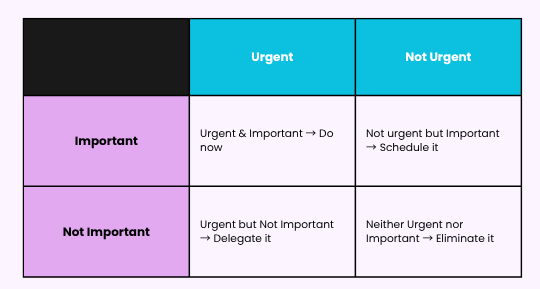
The Eisenhower Matrix, also known as the Urgent-Important Matrix, provides a structured approach to categorizing work and communicating priorities to your team. This framework divides all tasks into four quadrants based on two dimensions: urgency and importance
But tools only work if paired with habits. Here’s how to make prioritization stick:
- Anchor to goals: Ask, Does this task directly support team or business objectives?
- Define urgency: Set team-wide rules (e.g., urgent = within 24–48 hours).
- Use prioritization methods: ABC ranking, scoring, or impact vs. effort analysis.
- Protect time for strategic work: Block off space for long-term projects that often get drowned out by urgent requests.
- Revisit often: Priorities shift—check in regularly to reassess.
| Task Description | Urgent? | Important? | How to Classify |
| Something due today or within 24-48h, missing it will cause a major problem | ✔ | ✔/✖ | Urgent + Important → Do now (Quadrant 1) |
| Project that’s strategic, high value, but deadline is weeks away | ✖ | ✔ | Not urgent but Important → Schedule (Quadrant 2) |
| Someone asks you to handle a task that interrupts others but adds little long-term value | ✔ | ✖ | Urgent but Not Important → Delegate (Quadrant 3) |
| Low-value task, low impact, no deadline pressure | ✖ | ✖ | Neither → Drop or deprioritize (Quadrant 4) |
Time Management for Managers
Once tasks are assigned and prioritized, the next step is managing the clock. Time management isn’t just personal; it’s a team culture.
- Time-block for focus work
- eserve blocks of uninterrupted time for important tasks (especially Q2).
- During high-urgency periods, protect at least one block for planning or improvement.
- Minimize Context Switching
- Avoid having the team jump between multiple urgent tasks. Each switch carries a cognitive cost.
- Use a daily or weekly stand-up to surface urgent items, decide if they truly belong in Q1.
- Create Buffer Time
- Leave 10–15% of capacity unassigned so you can absorb emergent tasks without derailing all planned work.
- If you never have buffer, you’ll always feel reactive.
- Daily/Weekly Review
- At the end of the day/week: check what was done, what got delayed, what became urgent.
- Ask: Why did this shift become urgent? Could we see it coming? What can we do differently next time?
- Delegate and Outsource When Appropriate
- When your team is overloaded with urgent work, look at what can be delegated or outsourced
Utilizing Project Management Tools
Using a robust project management tool can significantly help you manage tasks, priorities and time more effectively. These tools act as the backbone of priority discipline.
Modern project management tools help teams coordinate, visualise, and execute work more clearly. They provide benefits such as improved collaboration, clearer roles, centralized tracking and better time management.
When There are too many high-priority items: Outsourcing can help
It happens: You’ve got more urgent & important items than you or your team can realistically handle. In those moments, outsourcing becomes a strategic lever—not a fallback.
- Delegate internally where possible: Move tasks that are urgent but less important (Q3) to other team members.
- Outsource external/third-party: If you’re facing capacity constraints, specialised third parties or staffing solutions can help take on tasks, freeing your team to focus on high-impact priorities.
- What you outsource matters: Non-core tasks, repetitive work, or functions requiring specialised support can be delegated externally.
- Choosing the right partner: Make sure the partner understands your goals, quality standards, timelines, and communicates clearly.
For example, if your internal team is working full tilt on product launches and strategic initiatives, you might outsource operational tasks such as HR administration, payroll, vendor management, or even content marketing. That frees your internal resources for the highest-value work.
Take the First Step to Scalability with Outsourcing
If you find yourself facing a backlog of high-priority tasks, or you need to augment capacity quickly, partner support can be a game-changer. That’s where Global ZenTech comes in.
- Global ZenTech offers end-to-end talent sourcing, employee management, staffing solutions and HR outsourcing services.
- We provide Business Process Outsourcing (BPO) for functions like HR, Accounting, Marketing and Sales.
- Our outsourcing model allows you to off-load operational work and maintain focus on strategic priorities.
By combining structured task assignment, rigorous prioritization (via the Eisenhower Matrix), disciplined time management, embedded project-management tools, and strategic outsourcing when needed, you create a team environment that is focused, aligned, and sustainable. And with the right partner, such as Global ZenTech, when internal capacity reaches its limit, you have a reliable way to expand capacity and keep momentum going.



 Global ZenTech