
A strong digital marketing team is no longer a luxury; it’s essential for startups aiming to drive awareness, generate demand, and accelerate growth. But unlike established enterprises with deep budgets and mature processes, startups must design lean, agile marketing teams that maximize impact with limited resources.
70% of startups identify digital marketing as essential to their success, most struggle with the complexities of assembling, managing, and scaling a complete marketing team. This challenge becomes even more acute when resources are limited and the pressure to demonstrate ROI is constant.
What Makes Digital Marketing Effective?
Digital marketing is not one thing, it’s a collection of disciplines and channels that work together to attract, engage, convert, and retain customers. A high-performing team understands how these facets interact and how to prioritize them based on business goals.
Key Facets of Digital Marketing
Modern digital marketing is multifaceted, requiring expertise across several interconnected disciplines. Understanding these core facets is the first step in building an effective marketing operation:
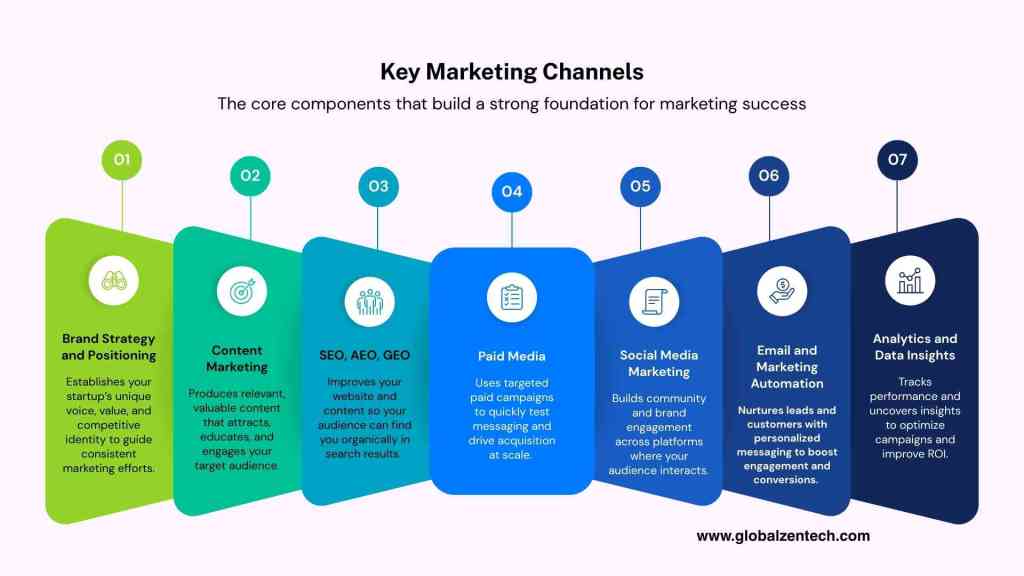
- Brand Strategy and Positioning
- Defines your startup’s voice, value proposition, and competitive narrative.
- Ensure all marketing efforts are cohesive and audience-aligned
- Content Marketing
- Creates useful, relevant content to attract target audiences.
- Includes blog posts, whitepapers, case studies, video and social content
- Search Engine Optimization, Answer Engine Optimization, Generative Engine Optimization(SEO, AEO, GEO)
- Optimize your website and content so target customers can find you organically.
- Focuses on keyword research, on-page SEO, technical SEO, and link strategy.
- Paid Media/ Performance Advertising
- Uses paid search, social ads, and programmatic to rapidly test messaging and scale acquisition.
- Social Media Marketing:
- Builds engagement and community across platforms where your audience lives
- Balance organic strategies with paid amplification
- Email and Marketing Automation
- Nurtures leads and customers through targeted sequences
- Improves retention, cross-sell, and lifecycle engagement
- Analytics and Data Insights
- Measures performance and informs optimization
- Includes tracking, reporting and experimentation frameworks
Key Channel Matrix
| Channel | Purpose | Strength |
| Organic Search (SEO) | Drive long-term traffic | Cost-effective, sustainable |
| Content Marketing | Build experience and trust | Supports all stages of the funnel |
| Paid Search (PPC) | Aquire targeted leads fast | Scalable with measurable ROI |
| Social Advertising | Audience engagement and awareness | Precision trageting, creative flexibility |
| Email Marketing | Retention and conversion | High ROI with presonalization |
| Influencer and Partnership Channels | Amplify reach | Credibility boosts early adoption |
| Referral and Affiliate | Performance-based growth | Cost-efficient acquisition |
SEO: The Foundation of AI Search Optimization
Search behavior is rapidly evolving. Traditional search engines like Google and Bing still drive massive organic traffic and demand optimization fundamentals that have been honed over decades. Even as AI-driven discovery grows, Search Engine Optimization (SEO) remains the foundation, because it ensures your brand appears in the first place when users look for information online. The core principles of SEO (strong site structure, relevant keywords, quality content, authoritative links) still help AI systems understand your content’s context, relevance, and credibility. This foundational strength makes SEO crucial even as new optimization disciplines emerge.
However, with the rise of AI-powered search and generative experiences, new strategies have developed to extend SEO’s reach and relevance. Two of the most talked-about are AEO and GEO.
What is AEO (Answer Engine Optimization)
Answer Engine Optimization (AEO) refers to structuring your content so that it can be used as a direct answer by AI search features and answer engines, for example, in Google’s AI overviews, featured snippets, voice assistants, or AI chat responses. The goal isn’t just to rank on a search results page; it’s to be the answer that the system delivers directly to the user. Content optimized for AEO uses clear, structured formats, question-based language, and semantic cues that help AI systems extract and display precise information without the user needing to click through.
What is GEO (Generative Engine Optimization)
Generative Engine Optimization (GEO) focuses on making your content discoverable, understandable, and citable by generative AI systems — such as large language models (LLMs) like ChatGPT, Gemini, Perplexity, or AI chat search features. Whereas SEO and AEO help your content be found or selected as an answer, GEO ensures your content is part of the information that AI tools pull from when generating responses. This means your content can be referenced, summarized, or used as source material in AI-generated answers, even when no direct link appears.
How SEO, AEO and GEO Work Together
Rather than replacing SEO, AEO and GEO build on its foundation:
- SEO gets your content ranked and indexed so users and AI systems can find it.
- AEO makes your content answer-ready, so it can be shown as a direct answer to user queries in AI-driven contexts.
- GEO helps ensure your content is included and referenced in generative AI outputs, extending your visibility into AI-driven discovery beyond traditional click-through results.
This layered approach future-proofs your content strategy for both organic and AI search results.
Building the Marketing Tech Stack
An effective tech stack enables automation, measurement, and scaling without ballooning headcount:
Core Tools:
- Analytics and Tracking
- Google Analytics/ GA4
- Heatmaps and session replay tools (e.g., Hotjar)
- Content & SEO
- SEO platforms (e.g., Ahrefs, SEMrush)
- Content management systems (WordPress, Hubspot CMS)
- Marketing Automation & CRM
- Marketing automation (HubSpot, Marketo, Klaviyo)
- CRM (Salesforce, Hubspot CRM)
- Paid Media Management
- Google Ads and Meta Ads Manager
- DSPs and bid management tools
- Collaboration and Project Management
- Asana, Trello, Notion, Slack for team coordination
- Social and Creative Tools
- Social Media Schedulers
- Creative Design Platforms
A strong stack includes CRM like HubSpot for lead management, marketing automation tools such as Marketo, CMS like WordPress, analytics via Google Analytics, and AI-driven platforms for personalization and attribution. Prioritize integrated, privacy-compliant tools with AI capabilities for 2026 efficiency.
Building Your Digital Marketing Team
Start with versatile roles: Marketing Lead for strategy, Content Marketer for assets, Paid Search Specialist for ads, Social Media Manager for engagement, and Analyst for performance tracking. As scaling occurs, add Growth Marketer, Marketing Ops Manager, and specialists in SEO or automation.
| Role | Focus Area | Why It Matters |
| Head of Marketing/ CMO | Strategy, alignment | Guides visions, prioritizes initiatives |
| Content Strategist/ Writer | Content creation | Fuels SEO, engages audiences |
| SEO Specialist | Organic growth | Boosts visibility and acquisition |
| Paid Media Manager | PPC and social ads | Drives performance marketing |
| Growth/ Performance Analyst | Data & insights | Optimize campaigns and improve ROI |
| Email and Automation Specialist | Lead nurturing | Personalizes engagement and retention |
| Social Media Manager | Community & brand | Builds presence and advocacy |
In early stages, team members may cover multiple responsibilities; what matters most is a foundation that can expand into specialized roles.
Challenges When Scaling a Digital Marketing Team
As startups grow, scaling a marketing team introduces operational and strategic challenges:
- Talent Acquisition and Diversity of Skills
- Hiring specialists (e.g., SEO experts, content strategists, paid media analysts) is competitive and costly.
- Early-stage startups often struggle to find multi-disciplinary marketers who can wear many hats.
- Alignment with Product and Sales
- Marketing must tightly align with product launches and sales pipelines, lack of alignment slows growth.
- Scaling teams without an integrated go-to-market strategy creates silos and inefficiencies.
- Keeping Pace with Tech and Trends
- Digital channels evolve rapidly, new platforms, privacy changes, and algorithm updates demand constant learning.
- Legacy tech or manual workflows can stunt the capacity to scale campaigns effectively.
- Budget and ROI Accountability
- Startups often operate with lead budgets and high performance expectations.
- Proving ROI early and consistently is essential, especially when leadership is prioritizing runway efficiency.
How Outsourcing Helps Startups Scale
Startups face unique resource constraints. Outsourcing alleviates these by enabling:
- Cost Efficiency and Flexibility
- Access experienced marketers without the overhead of full-time salaries, benefits, and training.
- Scale team support up or down based on growth phases and campaign priorities.
- Faster Time to Value
- Plug into read-built expertise and frameworks instead of building capabilities from scratch.
- Enable rapid testing, iteration, and learning with minimal ramp time.
- Access to Best-In-Class Tools and Processes
- Outsourced teams bring a proven tech stack and optimized workflows.
- Avoid costly missteps and shorten the learning curve.
- Strategic Depth & Fresh Perspective
- Experienced practitioners bring broader insights from working across industries.
- Helps refine messaging, targeting, and positioning with proven playbooks.
How Global ZenTech Can Help
Global Zentech specializes in building tailored digital marketing teams that scale with your startup’s growth. We offer:
- Team Augmentation: We embed skilled marketers, content creators, SEO specialists, paid media experts, and growth analysts directly into your workflows.
- Flexible Engagement Models: From project-based support to long-term team builds, we align your budget and business milestones
- Tech Stack Implementation and Optimization: We help you select, integrate, and manage the right tools that increase efficiency and deliver measurable growth.
- Strategic Marketing Leadership: Our experienced leadership support ensures your digital strategy aligns with product goals, sales pipelines, and audience needs.
- Results-Driven Performance: We prioritize outcomes and transparent reporting so you always know where your marketing investment is generating impact.
For startups, building a digital marketing team is a journey, not a checkbox. With the right structure, skill mix, tech stack, and strategic support, your team becomes a growth engine. And when resources are limited, partnering with an experienced outsourcing provider like Global Zentech can accelerate results, amplify capabilities, and unlock higher impact at scale.
 Global ZenTech