

A recruitment pipeline is a structured process that guides startups from identifying hiring needs to onboarding new team members, ensuring efficient talent acquisition. For startups building remote teams in the Philippines, this pipeline helps tap into a skilled talent pool while addressing unique challenges like time zones and compliance.
What is a Recruitment Pipeline?
A recruitment pipeline is a system framework that guides candidates from initial awareness of your company through their first day as an employee. It is a structured pathway that transforms potential candidates into product team members once selected and onboarded. This ensures a consistent flow of qualified talent aligned with your organization’s needs.
This framework maintains a pool of engaged candidates at various stages of readiness, allowing your startup to move quickly when hiring needs arise. This is particularly crucial for startups when timing can directly impact product development, market opportunities, and competitive positioning.
For companies building remote teams, especially those tapping into the Philippine talent market, a well-designed pipeline ensures you’re not just filling seats, but strategically building teams that can drive your business forward across timezones.
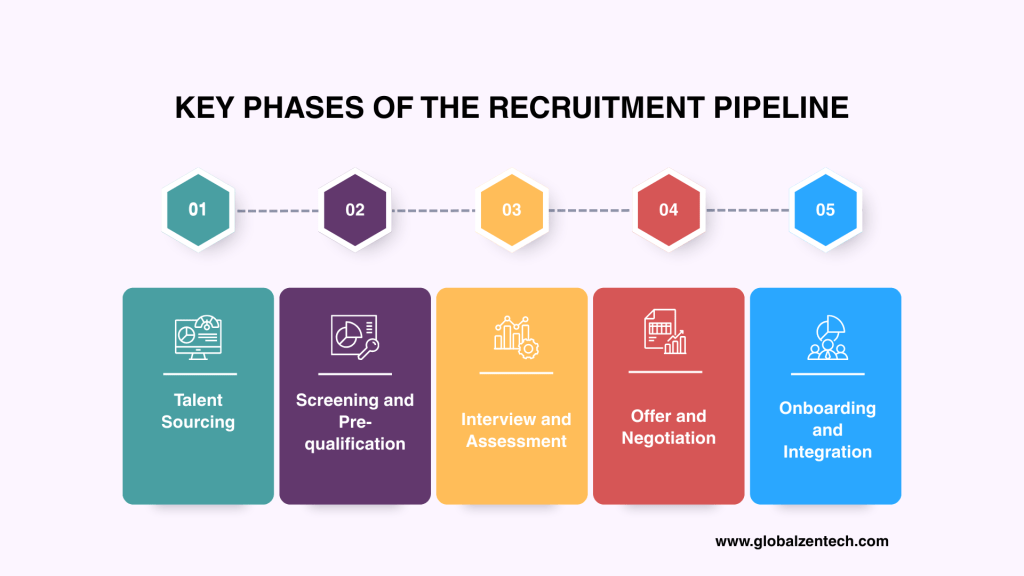
The Key Phases of the Recruitment Pipeline
| Phase | Description | Key Activities | KPIs |
| Talent Sourcing | This initial phase focuses on identifying potential candidates and creating awareness of your company as an employer. It involves both passive sourcing (building talent pools for future needs) and active sourcing (seeking candidates for immediate openings) | 1. Building your employer brand through content, social media, and thought leadership. 2. Leveraging job boards, professional networks, and recruitment platforms 3. Developing relationships with universities, professional organizations, and communities 4. Creating compelling job descriptions that resonate with remote workers 5. Utilizing employee referral programs | 1. Number of qualified candidates entering the pipeline 2. Source of hire 3. Time to fill talent pool quotas 4. Cost per candidate sources 5. Application completion rate 6. Career page traffic and engagement metrics |
| Screening and Pre-qualification | This phase involves reviewing applications and conducting initial assessments to determine which candidates meet the basic requirements and cultural fit for your organization | 1. Resume and application review 2. Initial phone or video screenings 3. Skills assessments and pre-employment test 4. Background and reference checks 5. Cultural fit evaluations | 1. Screening completion rate 2. Time to screen (average days from application to screening completion) 3. Screening pass rate (percentage advancing to interviews) 4. Recruiter productivity (applications screened per day) 5. Candidate drop-off rate at screening stage 6. Quality of screen (correlation between screening scores and eventual hire success) |
| Interviewing and Assessment | This critical phase involves deeper evaluation through structured interviews, technical assessments, and competency evaluations to determine best candidate-role fit. | 1. First-round interviews (typically with HR or hiring managers) 2. Technical or skills-bsaed assessments 3. Second-round interviews (with team members and stakeholders) 4. Final interviews (with senior leadership) 5. Work sample evaluations, portfolio or trial projects | 1. Interview-to-offer ratio 2. Average number of interview rounds 3. Time in interview stage 4. Interview satisfaction scores 5. Candidate experience ratings 6. Assessment score distributions 7. No-show rate for scheduled interviews |
| Offer and Negotiation | This phase encompasses extending job offers, negotiating terms, and securin candidate acceptance while maintaining engagement throughout the decision-making process. | 1. Preparing competitive offer packages 2. Presenting offers and benefits clearly 3. Negotiating salary, benefits, and start dates 4. Addressing candidate questions and concerns 5. Maintaining communication during decision period | 1. Offer acceptance rate 2. Time from offer to acceptance 3. Offer decline reasons (when tracked) 4. Counteroffer rate 5. Salary competitiveness ration (offered vs market rate) 6. Time to offer ( from application to offer extended) |
| Onboarding and Integration | The final phase ensures new hires transition smoothly into their roles, become productive quickly, and integrate successfully into youe compay culture, particularly critical for remote team members | 1. Pre-boarding communication and preparation 2. First-day orientation and welcome activities 3. Training on systems, tools and processes 4. Role- specific training and mentorship 5. Regular check-ins during the first 90 days 6. Cultural integration and team introductions | 1. Time to productivity (time until new hire reaches expected output 2. 30-60-90 day retention rates 3. New hire satisfaction scores 4. Manager satisfaction with new hire performance 5. Onboarding completion rate 6. First-year turnover rate 7. New hire referral likelihood (NPS). |
Best Practices for Building a Recruitment Pipeline for Remote Teams in the Philippines
Develop a Remote-First Recruitment Strategy
When hiring remote teams in the Philippines, your recruitment approach must be intentionally designed for distributed work. This means clearly communicating your remote work culture, expectations around asynchronous communication, and how your team collaborates across time zones. Philippine talent is highly skilled in remote work dynamics, but clarity around your specific operating model will attract candidates who align with your approach.
Implementation:
- Create detailed documentation about your remote work practices
- Highlight flexibility, autonomy, and trust in your employer brand
- Showcase your remote team culture through video testimonials and virtual office tours
- Be transparent about working hours expectations and time zone overlap requirements
Leverage Technology Throughout the Pipeline
Technology is the backbone of effective remote recruitment. Implement an Applicant Tracking System (ATS) to manage candidate flow, use video interviewing platforms that work reliably with the Philippine internet infrastructure, and employ skills assessment tools that provide objective data on candidate capabilities.
Implementation:
- Invest in an ATS that integrates with your other HR systems
- Use collaborative hiring platforms that allow team input
- Implement skills testing relevant to remote work (e.g., written communication, self-management)
- Ensure all technology is accessible and user-friendly for candidates in the Philippines
Build Relationship with Local Talent Communities
The Philippines has vibrant professional communities, industry groups, and tech meetups. Establishing a professional presence in these communities creates a continuous talent pipeline and positions your startups as an employer of choice in the market.
Implementation:
- Participate in virtual and in-person industry events in the Philippines
- Partner with universities and training institutions in major cities like Manila, Cebu, and Davao
- Engage with Filipino professional groups on LinkedIn and Facebook
- Support local tech communities and open-source projects
Optimize Hiring for the Philippine Market
Understanding the unique aspects of the Philippine job market is crucial. Filipinos value career growth, competitive compensation packages that consider local cost of living, comprehensive benefits, and companies that demonstrate long-term commitment to their market presence.
Implementation:
- Research competitive salary ranges specific to the Philippine market rates
- Offer benefits that matter locally (HMO coverage, government-mandated benefits, internet allowances)
- Provide clear career progression pathways
- Emphasize professional development and skills training opportunities
- Consider Philippine holidays and cultural observances in your scheduling
Establish Clear Communications Protocols
Effective communication is the foundation of successful remote hiring. Candidates should never wonder about next steps or where they stand in your process. This is especially important when working across time zones.
Implementation:
- Set clear expectations for response times at each stage
- Provide regular updates even when there’s no immediate movement
- Create automated communications for common touchpoints
- Assign a dedicated point of contact for each candidate
- Be mindful of time zone differences when scheduling interviews and communications
Create a Structured Interview Process
Consistency in your interview process ensures fair evaluation and helps you make better hiring decisions. For remote roles, your interview process should also assess remote work competencies.
Implementation:
- Develop standardized interview scorecards
- Train interviewers on remote interviewing best practices and unconscious bias
- Include assessments for remote work skills (written communication, autonomy, time management)
- Involve remote team members in the interview process
- Conduct working sessions or trial projects when appropriate
Invest in Candidate Experience
Your recruitment process is often a candidate’s first extended interaction with your company. A positive experience, regardless of outcome, builds your employer brand and creates advocates in the market.
Implementation:
- Simplify your application process (mobile-friendly for Philippine users)
- Provide clear job descriptions with realistic expectations
- Offer constructive feedback when possible
- Make the interview process engaging and respectful of candidates’ time
- Follow up with all candidates, even those not selected
Build Pipeline Diversity
The Philippines offers incredible diversity in talent backgrounds, experiences, and perspectives. Actively building diversity into your pipeline strengthens your team and expands your access to top talent.
Implementation:
- Write inclusive job descriptions that focus on skills and potential
- Source from diverse channels and communities
- Review pipeline data regularly for diversity metrics
- Train hiring teams on inclusive interviewing practices
- Consider candidates from different regions of the Philippines, not just Metro Manila
Overcoming Key Challenges in Remote Team Recruitment
- Challenge 1: Time Zone Differences: Coordinating interviews and communications across significant time zones can slow down your recruitment process and create candidate frustration.
- Solution:
- Establish core hours where your team overlaps with Philippine business hours
- Use asynchronous video interviews for initial screenings
- Schedule interviews well in advance with flexible options
- Rotate the interview time burden fairly among your team
- Communicate clearly about expected response times
- Solution:
- Challenge 2: Assessing Remote Work Competencies: Not every skilled professional excels in remote work environments. Assessing for remote-specific skills alongside technical capabilities is challenging but essential
- Solution:
- Include remote work scenarios in your interview questions
- Assess written communication skills throughout the process
- Look for evidence of self-direction and accountability in past experiences
- Conduct working sessions that simulate your actual work environment
- Check references specifically about remote work performance
- Solution:
- Challenge 3: Building Trust Remotely: Creating the personal connection and trust that facilitates a hiring decision is more difficult without in-person interaction.
- Solution:
- Use video for all substantive interactions
- Schedule informal “coffee chat” conversations with team members
- Share authentic insights into your company culture through various marketing channels
- Be transparent about challenges and opportunities
- Solution:
- Challenge 4: Competitive Market for Top Talent: The Philippines has become increasingly competitive for skilled professionals, particularly in technology, customer service, and business operations roles.
- Solutions:
- Move quickly through your recruitment pipeline
- Offer competitive total compensation packages
- Differentiate on culture, mission, and growth opportunities
- Provide clear career pathways and professional development
- Build your employer brand consistently in the market
- Solutions:
- Challenge 5: Ensuring Compliance and Legal Requirements: Navigating employment regulations, tax implications, and compliance requirements across borders adds complexity to remote hiring.
- Solutions:
- Partner with Employer of Record (EOR) providers who understand Philippine labor law
- Ensure contracts comply with both your jurisdiction and Philippine regulations
- Understand mandatory benefits and statutory requirements
- Work with legal experts for employment agreements
- Stay updated on changing regulations affecting remote employment
- Solutions:
- Challenge 6: Maintaining Pipeline Health: Keeping candidates engaged throughout a potentially lengthy recruitment process, especially when time zones create natural delays, requires intentional effort.
- Solutions:
- Communicate proactively about timeline expectations
- Provide regular updates even without major developments
- Share relevant content about your company and culture during the process
- Set up automated touchpoints at key intervals
- Maintain a talent pool for future opportunities
- Solutions:
How Global ZenTech Can Help
Global ZenTech specializes in end-to-end talent sourcing, vetting, and staffing for Philippine remote teams, handling background checks, skills assessments, and cultural alignment to minimize hiring risks. We provide infrastructure support like backup connectivity, plus HR administration, payroll, and compliance management, allowing startups to focus on growth.
- strategic workforce planning and role definition
- Candidate sourcing, screening, and interviewing support
- Local market insights to attract, engage, and retain top remote talent
- KPI tracking and process improvements to make your hiring efficient and repeatable
Whether you’re filling early engineering roles or scaling an entire remote team, we provide the tools, people, and strategy to help you hire smartly and sustainably.


 Global ZenTech